No install needed · Free · Browser-based
Convert AVI to GIF: Free Online Tool for Legacy Video Files
I found a folder of .avi demo clips from 2004 in a product archive and the client needed a short loop as a GIF for a landing page — the old AVI opened without codec issues and the output GIF worked immediately. AVI files are everywhere if you have old video content. These files came from Windows computers, security cameras, or legacy recording software. But AVI files don't play well on modern devices and social media platforms.
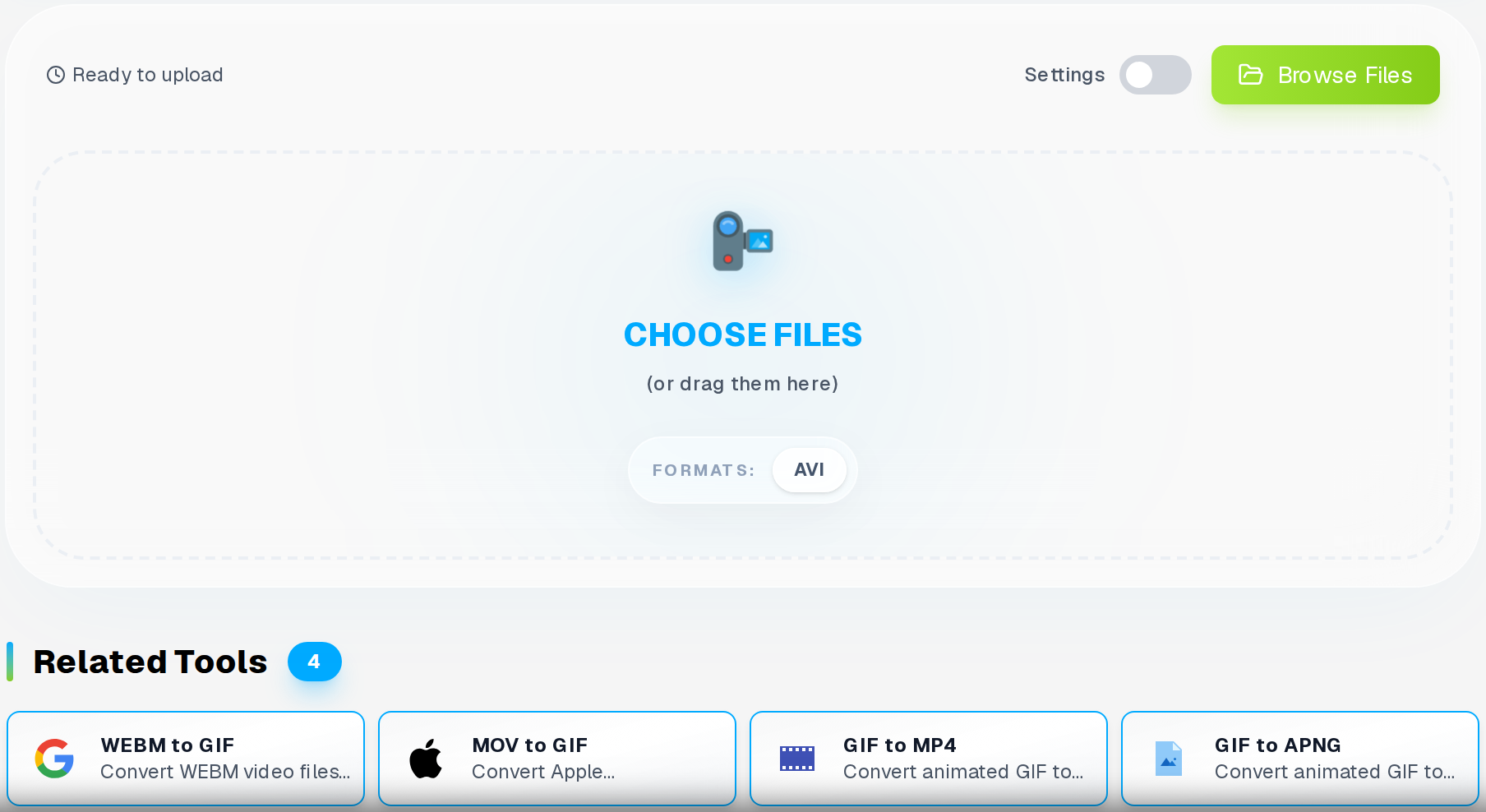
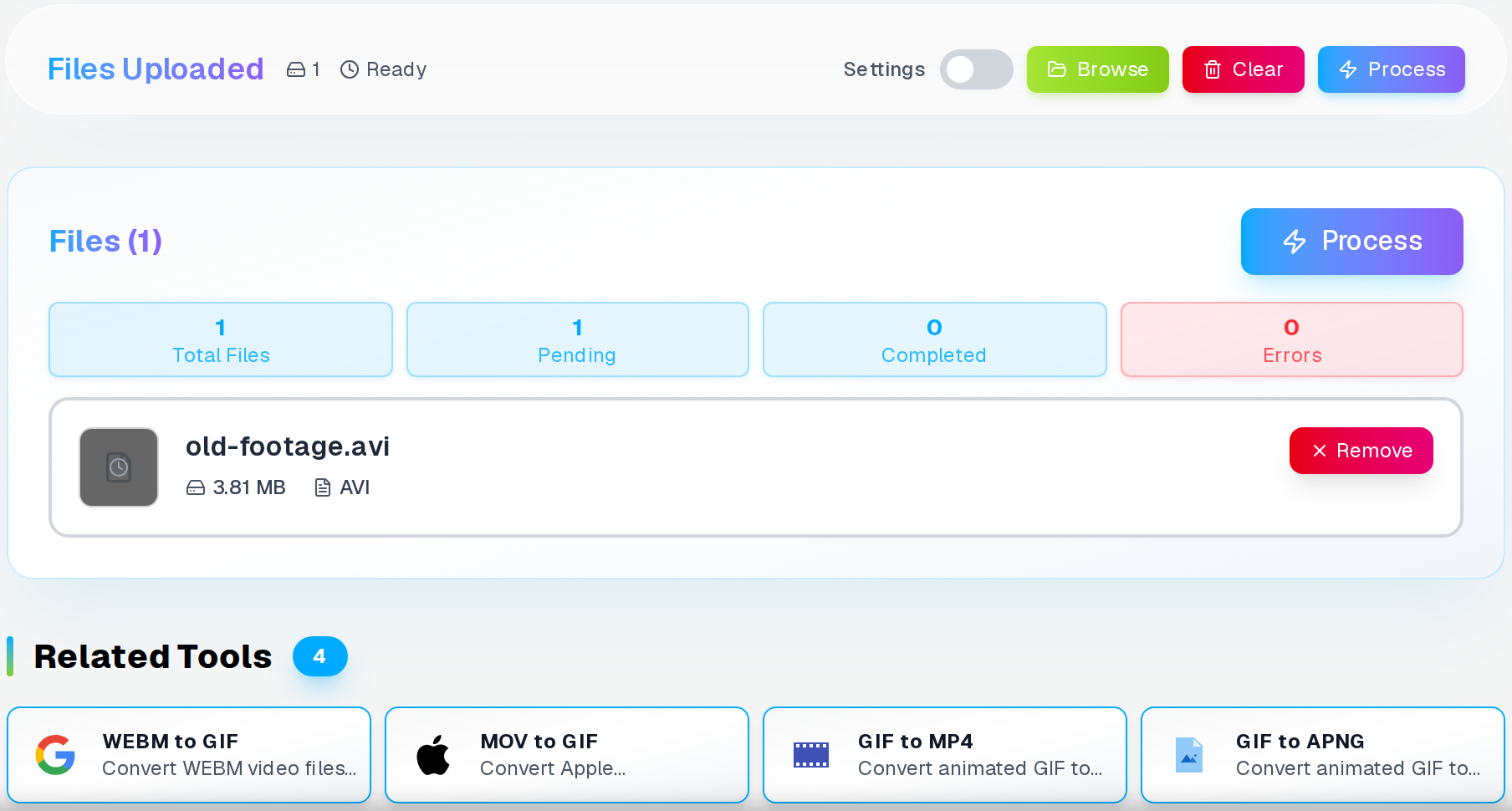
This is the tool state right after the AVI file has been accepted — duration and resolution confirmed, no settings changed yet.
Converting AVI to GIF solves this problem instantly. GIF files work everywhere. For smaller, sharper output, convert the GIF to MP4. No special software needed.
Why Convert AVI Files to GIF Format
GIF too big?
Convert your GIF to MP4 for a file that's 60% smaller with far better quality for video platforms and social media.
GIF to MP4 →AVI is a container format from 1992. It holds video data compressed with different codecs like DivX, Xvid, or MJPEG. These codecs aren't always available on modern devices.
Your AVI file might play perfectly on one computer but fail completely on another. This happens because the viewing device lacks the required codec.
GIF files eliminate this problem entirely. Every device, browser, and platform supports GIF natively. Once you convert AVI to GIF, your video content becomes universally accessible.
Common AVI File Sources
Most AVI files come from these sources:
- Windows Movie Maker projects from XP and Vista era
- Security camera recordings and surveillance systems
- Screen capture software like Camtasia or HyperCam
- Downloaded videos from early internet file sharing
- DVD rips and movie backups from the early 2000s
- Game recordings and gameplay footage
How to Convert AVI to GIF Online
Our converter makes AVI to GIF conversion simple and secure. The entire process runs in your browser. No files get uploaded to external servers.
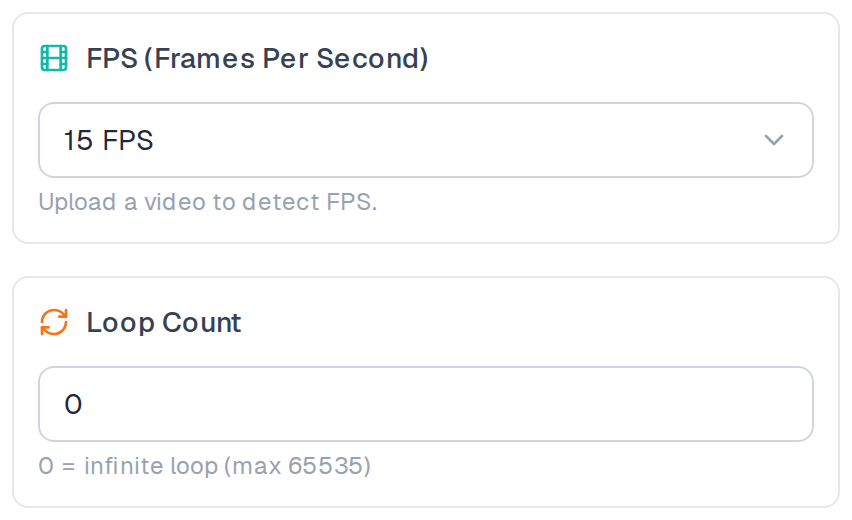
Opening settings reveals the three controls that determine output quality and file size.
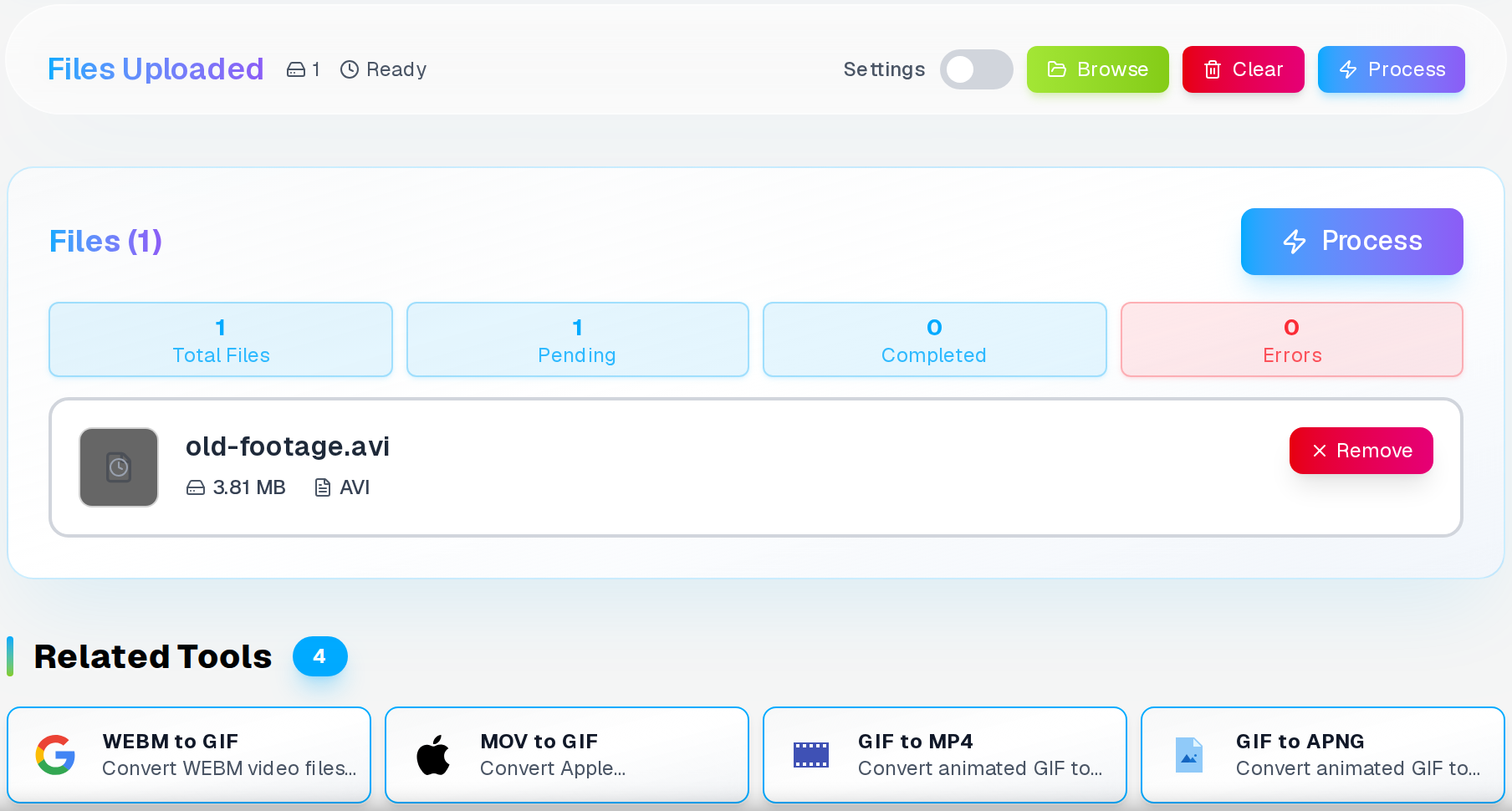
Step 1: Upload Your AVI File
Drag and drop your AVI file onto the converter or click the upload button. The tool accepts files of any size and supports all AVI codecs automatically.
Large AVI files may take a moment to load. This is normal since AVI files from older systems tend to be bigger than modern video formats.
Step 2: Configure Your Settings
Once uploaded, you'll see the settings panel. Here's what each option does:
Frame Rate (FPS): Choose between 1-30 frames per second. Higher FPS creates smoother motion but larger file sizes. The converter detects your source video's frame rate and suggests optimal settings.
Width: Set your desired GIF width in pixels. Leave blank to keep the original size. The height adjusts automatically to maintain proper aspect ratio.
Trim Controls: Select which part of your video to convert. Set start and end times to create short, focused GIF clips. Most platforms work best with GIFs under 10 seconds.
Loop Count: Set how many times the GIF repeats. Zero means infinite looping. Higher numbers create files that stop after playing the specified number of times.
Compression: Control file size versus quality. Lower compression preserves more detail but creates larger files. Higher compression reduces file size but may affect image quality.
Speed Control: Make your GIF play slower or faster than the original video. This helps emphasize important moments or create dramatic effects.
Step 3: Convert and Download
Click the Convert button to start processing. The conversion happens entirely on your device using browser technology. No data leaves your computer.
Download completes automatically when conversion finishes. You get a clean GIF file with no watermarks or branding.
Best Settings for AVI to GIF Conversion
Need better animation quality?
Convert your GIF to APNG for millions of colours and full transparency — far better quality than standard GIF.
Different types of AVI content work best with specific settings. Here are proven configurations:
Security Camera Footage
Security cameras typically record at low frame rates with grainy quality. Use these settings:
- FPS: 10-15 (matches original recording rate)
- Width: 320-480 pixels (keeps file size manageable)
- Compression: Medium to high (reduces noise)
- Trim: Focus on key events or incidents
Home Videos and Webcam Content
Personal recordings usually have better quality and higher frame rates:
- FPS: 15 (good balance of smoothness and size)
- Width: 480 pixels (maintains detail without bloat)
- Compression: Low to medium (preserves quality)
- Trim: Keep clips under 5 seconds for social sharing
Screen Recordings and Tutorials
Screen captures have less motion but higher detail requirements:
- FPS: 10-12 (adequate for showing interface changes)
- Width: 640 pixels (keeps text readable)
- Compression: Medium (balances clarity and file size)
- Trim: Show specific actions or processes clearly
Settings Cards
FPS and loop for legacy AVI files
Old AVI recordings from security cameras often run at 5–10 FPS natively. Matching the source frame rate avoids duplicated frames that add file size without adding motion. For home video AVI from camcorders, 15 FPS captures the feel without making the GIF enormous.
Loop count 0 (infinite) is correct for sharing highlights. If converting a surveillance clip that tells a specific story, loop count 1 means it plays once and stops.
File Size Considerations
GIF files can become very large, especially from high-quality AVI sources. Here are strategies to keep sizes reasonable:
Shorter Duration: Each second of video significantly increases file size. Trim your clips to show only essential content.
Lower Frame Rate: Reducing from 30fps to 15fps can cut file size in half with minimal quality loss for most content.
Smaller Dimensions: Reducing width from 720px to 480px dramatically decreases file size while maintaining clarity on most viewing devices.
Strategic Compression: Increase compression for backgrounds or static areas. Preserve detail for areas with important motion or text.
Quality Optimization Tips
A few format constraints worth knowing before you adjust settings:
GIF uses a 256-color palette per frame. This works well for graphics, cartoons, and simple video content. Photographic content may show color banding or dithering patterns.
AVI files often contain more colors than GIF can display. The converter automatically selects the best 256 colors for each frame to minimize quality loss.
Motion blur in the original AVI helps GIF conversion. Sharp, detailed motion can create large file sizes and quality issues. Consider increasing compression for high-motion scenes.
Privacy and Security Benefits
Processing AVI files locally protects your content privacy. Security camera footage, personal videos, and confidential recordings never leave your device.
Traditional online converters upload your entire file to external servers. This creates privacy risks and potential data breaches. Our browser-based processing eliminates these concerns completely.
Large AVI files also benefit from local processing. No waiting for uploads or downloads. No bandwidth limitations or server timeouts.
When conversion finishes, the result panel shows the original AVI weight against the GIF output — the gap is usually dramatic.
Frequently Asked Questions
Can I convert multiple AVI files to GIF at once?
One file at a time for optimal quality control.
Why is my AVI file so much larger than the resulting GIF?
AVI is a container format, not a compression standard. The video inside your AVI file may be completely uncompressed — raw frames — or lightly compressed with an old codec like Cinepak that was designed for 1990s CD-ROM bandwidth, not file size. Either way, the raw video data is many times larger than what GIF stores. GIF also drops the audio track entirely, which for a 10-minute recording can be a significant portion of the file. The result is that a 500MB AVI often produces a 5–20MB GIF of the same 5-second clip.
What happens if my AVI file uses an unsupported codec?
Our converter handles all standard AVI codecs including DivX, Xvid, MJPEG, Cinepak, and Indeo. Modern browser technology provides extensive codec support, so compatibility issues are extremely rare.
Can I preserve the original AVI quality in GIF format?
GIF has inherent limitations compared to full video formats. You'll see some quality reduction due to the 256-color palette and compression requirements. However, our optimization ensures the best possible GIF output from your AVI source.
Is there a file size limit for AVI uploads?
Browser processing can handle very large AVI files, but extremely large files may cause performance issues on older devices. For files over 500MB, consider using video compression tools first to reduce the source file size before conversion.
Have a MOV or WebM to convert?
Convert MOV or WebM videos to GIF with the same quality controls — perfect for iPhone and browser-recorded clips.
Related Articles
Convert PDF to EPUB for Kindle and E-Readers - Free Online Tool
Convert PDF documents to EPUB format for Kindle and e-readers. Fix text reflow issues and make your PDFs readable on any device. Free online converter.
Read articleOrganize PDF Free - Rearrange, Rotate, and Merge Pages Without Software
Organize PDF pages with drag-and-drop reordering, rotation, blank page insertion, and multi-file merging. Professional PDF management with real-time preview and batch operations. Advanced document workflows with touch-optimized controls.
Read articleConvert APNG to GIF for Wider Compatibility
Convert APNG files to GIF format for better browser support. Free online tool with custom FPS, compression, and loop controls. No registration required.
Read article