Free · Up to 85% smaller · No signup
Convert GIF to MP4 for Smaller, Sharper Files
A looping screen recording GIF I embedded in a GitHub README noticeably slowed page load — converting to MP4 video reduced the payload by around 85% and the page loaded normally again. A GIF that looks fine on your machine can be 10x the size of an equivalent MP4 — and social platforms re-compress them again on upload. Converting to MP4 solves both problems at once. If color fidelity matters for your animation rather than file size, converting GIF to APNG is worth considering since APNG supports millions of colors without GIF's 256-color restriction.
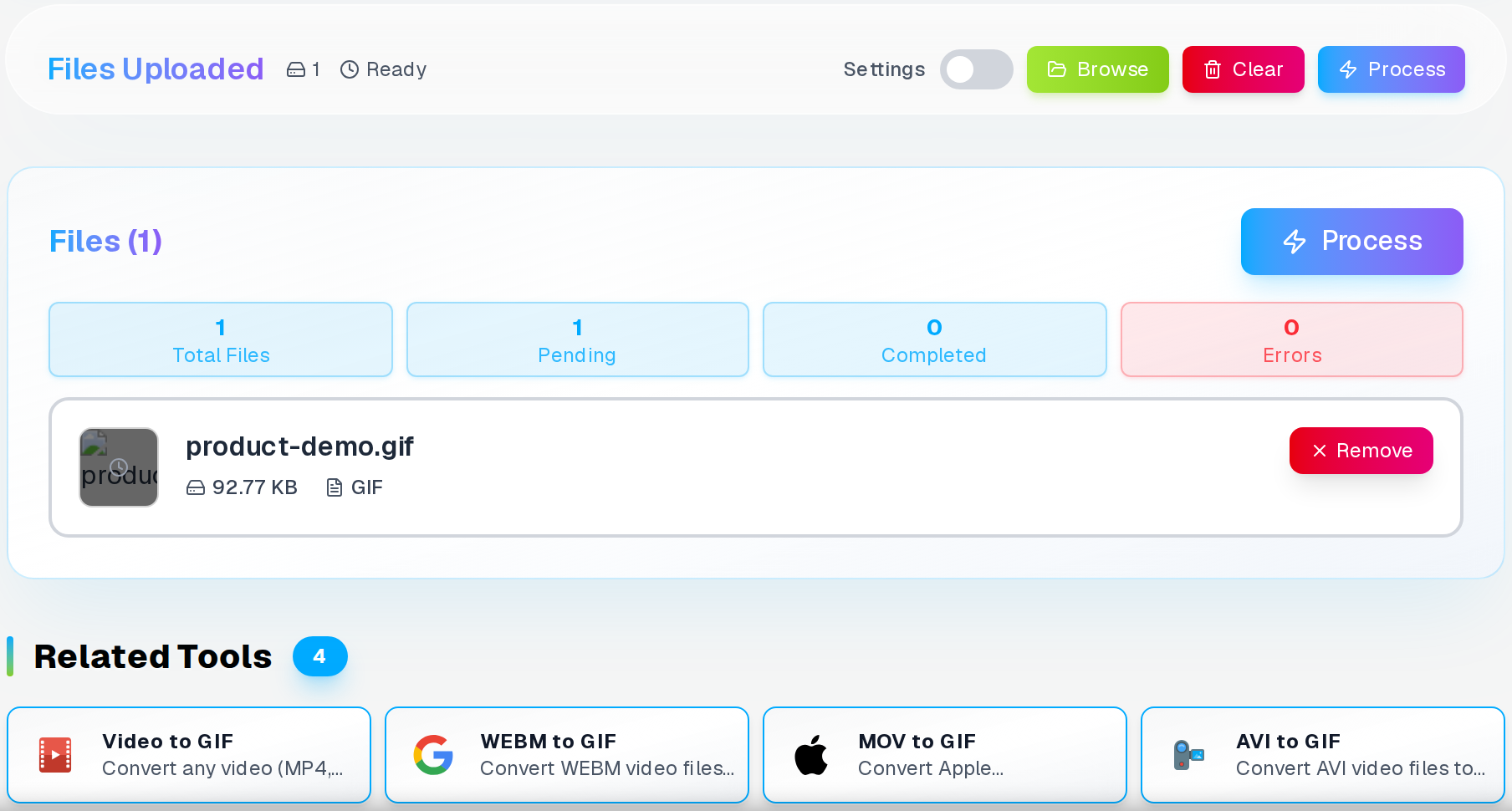
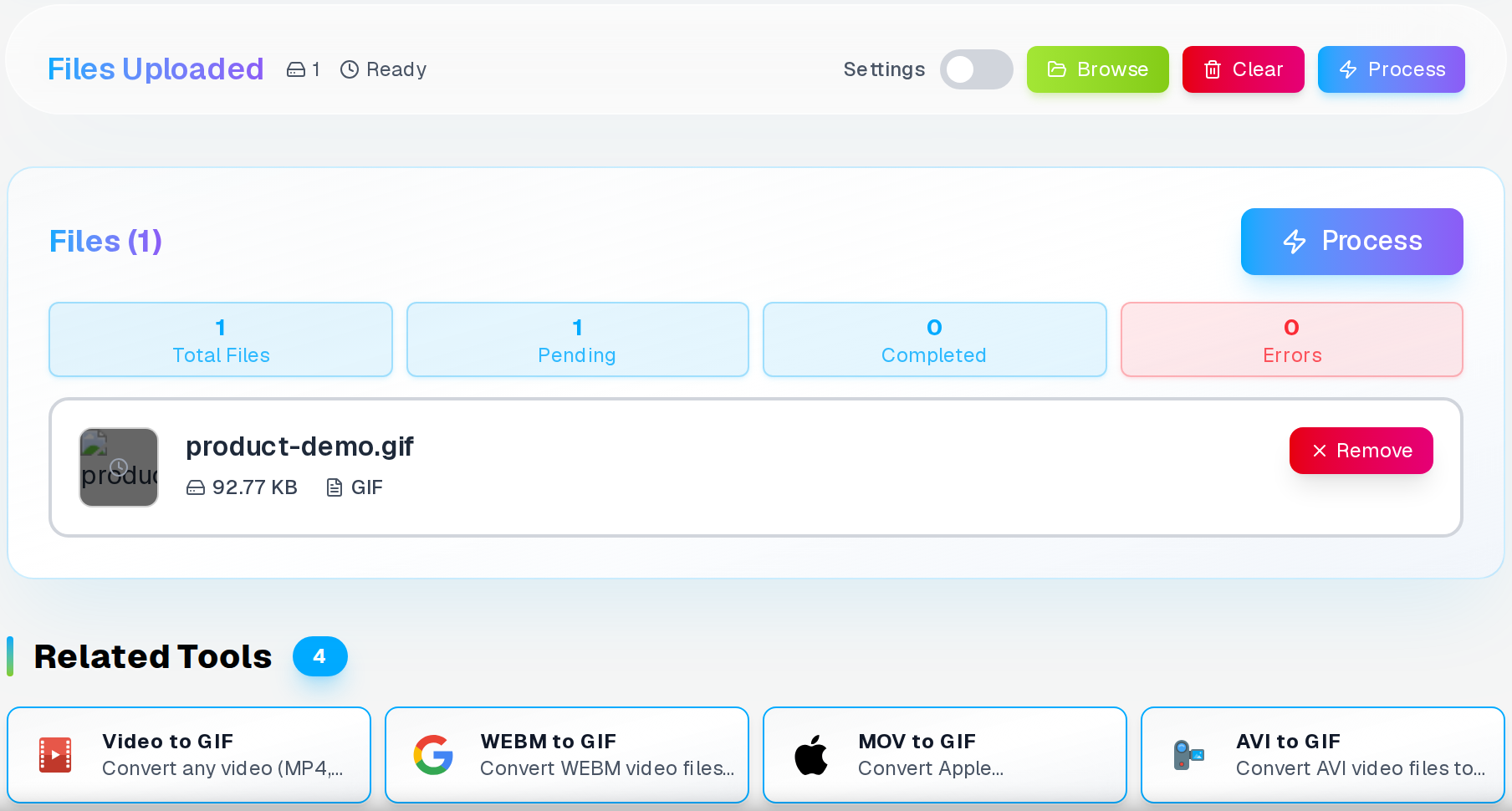
This is the tool the moment the GIF file has been accepted — duration, frame count, and resolution are read before the settings button activates.
MP4 files are typically 60-80% smaller than GIFs with noticeably better quality. They load faster, play smoothly on mobile, and social platforms handle them better than GIF uploads.
Why GIF Files Are So Large
I converted a 12MB GIF demo animation for a product page last quarter. Same clip as MP4: 1.8MB, visibly sharper text rendering, and it passed Slack's upload limit without manual compression. The GIF version had been sitting in a Jira ticket for two weeks with a note saying"too big to upload." Five-minute fix.
Want better GIF quality?
Convert your GIF to APNG for millions of colours and full transparency — much better quality at similar file size.
GIF to APNG →GIF format stores every single frame as a complete image. A 5-second animation at 20 frames per second contains 100 individual images.
Each frame is saved separately with no compression between frames. This means repeated elements like backgrounds get stored over and over again.
Modern video formats like MP4 only store the differences between frames. Static backgrounds are saved once, not 100 times.
File Size Problems with GIF
- Each frame stored as complete image increases file size
- No compression between similar frames wastes space
- Long animations become massive files that are hard to share
- Slow loading times frustrate users on mobile connections
- Email and messaging apps often reject large GIF files
How MP4 Makes Files Smaller
MP4 uses advanced video compression that only saves what changes between frames. If the background stays the same, it gets stored once.
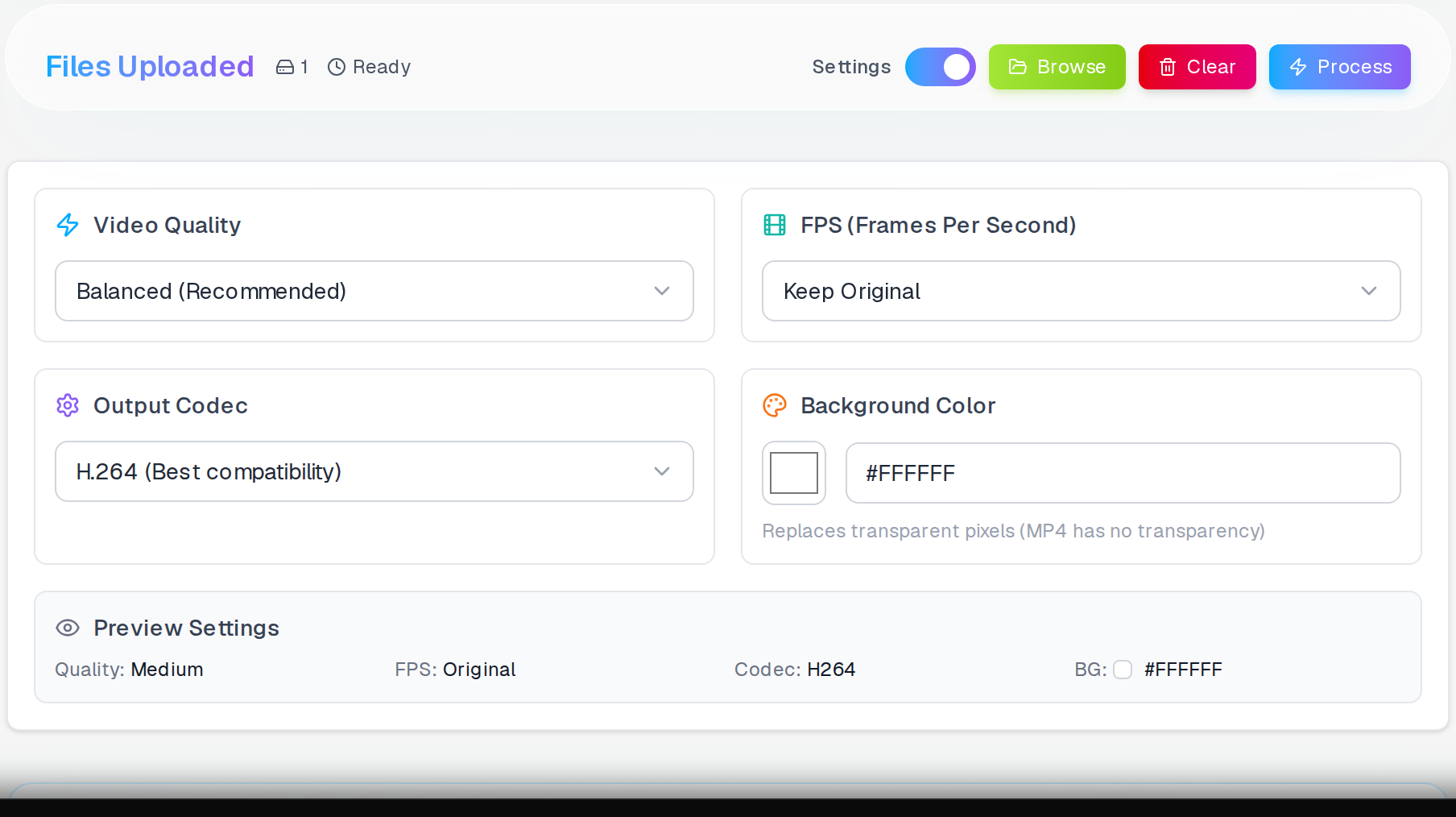
Three settings control the output video: frame rate, codec, and background colour for transparent GIF regions.
Motion estimation tracks how objects move across frames. Instead of storing the object in each frame, MP4 saves movement instructions.
This compression typically reduces file size by 60-80% compared to GIF while maintaining better visual quality.
How to Convert GIF to MP4
Converting your animated GIFs to MP4 format takes just a few clicks. The conversion tool handles all the technical settings automatically.
- Upload your GIF file: Drag your animated GIF into the converter or click to select files from your computer
- Choose quality settings: Pick high, medium, or low quality based on your needs (medium recommended)
- Set frame rate: Keep original FPS or choose 24/30/60 FPS for different use cases
- Select codec: H.264 for compatibility or H.265 for smaller files
- Convert and download: Click convert and download your optimized MP4 file
The conversion typically takes 30-90 seconds depending on your GIF length and settings. Longer animations and higher quality take more time.
Quality and Codec Settings
The converter gives you control over video quality and codec choice. These settings balance file size with visual quality.
Quality Options
- High Quality: Best visual results but larger file size
- Medium Quality (Recommended): Good balance of size and quality
- Low Quality: Smallest files but some quality loss
Codec Selection
- H.264: Works everywhere, good compression, best compatibility
- H.265: 25% smaller files, newer format, requires modern devices
For most uses, H.264 codec with medium quality gives the best results. It plays on all devices and social media platforms.
Settings Cards
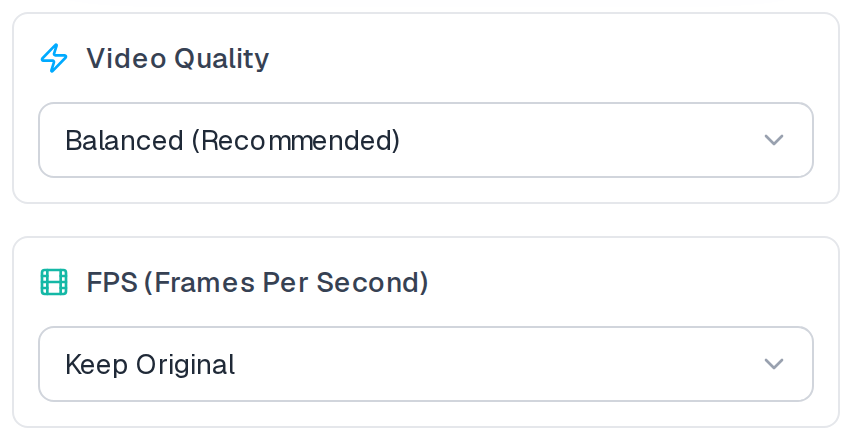
Quality and FPS — two linked controls
Quality sets the encoder's CRF value — lower numbers keep more bits per frame, higher numbers discard more detail. The FPS card below it determines how many frames are sampled from the source GIF before any encoding runs.
Set quality first to match your visual standard, then reduce FPS if the output is still too large. Switching codec from H.264 to H.265 has a bigger impact on size than adjusting quality by one notch.
Frame Rate and Background Color
Create a GIF from video clips?
Convert MOV, AVI, or WebM videos to GIF with custom FPS, dimensions, and speed settings.
Frame rate controls how smooth your animation looks. Higher frame rates create smoother motion but increase file size.
Background color matters because MP4 does not support transparency like GIF. Choose white for web use or match your target background.
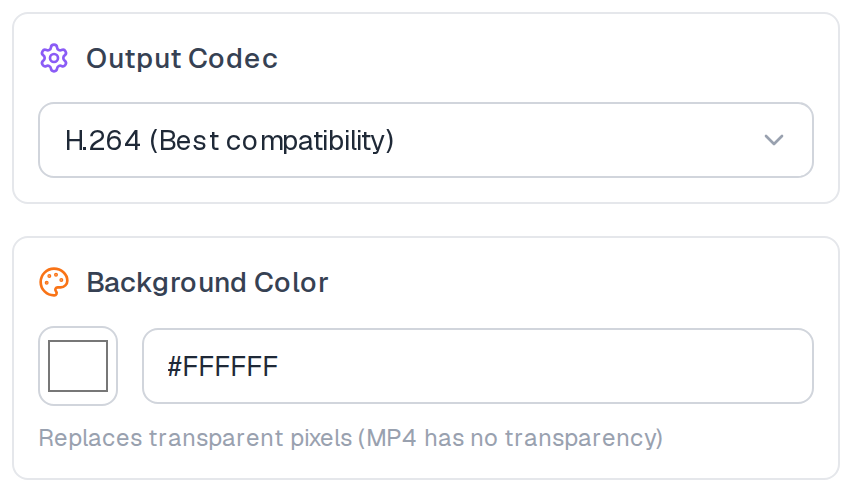
Settings Cards
Codec and background — what they actually do
H.264 works on every device made after 2010. H.265 produces files ~25 % smaller but requires hardware decode support that older iPhones, Samsung TVs, and smart displays often lack.
GIFs can have transparent frames; MP4 cannot. The background-colour card fills those transparent pixels with whatever colour you pick. White is safe for web. Match your site's background colour and the transition looks invisible.
Frame Rate Guide
- Keep Original: Preserves the timing from your GIF
- 24 FPS: Cinema standard, good for artistic content
- 30 FPS: Web video standard, smooth playback
- 60 FPS: Very smooth, best for gaming or UI animations
MP4 vs GIF Comparison
| Feature | GIF | MP4 |
|---|---|---|
| File Size | Large | 60% smaller |
| Quality | 256 colors, pixelated | Full color, sharp |
| Loading Speed | Slow | Fast |
| Device Support | Universal | All modern devices |
| Social Media | Gets compressed | Native format |
Best Use Cases for MP4
Social Media
Instagram, Twitter, and TikTok prefer MP4 format. Your content loads faster and looks better.
Website Animations
Faster page loading and better user experience with smaller file sizes.
Email Marketing
Small MP4 files fit email size limits while maintaining visual impact.
Mobile Apps
Reduced data usage and faster loading on mobile connections.
When to Keep Using GIF
GIF still makes sense for simple animations with solid colors. Pixel art, logos with few colors, and basic graphics work fine as GIF.
If you need transparency and the animation is very simple, GIF might be better. However, consider PNG sequences for high-quality transparent animations.
For everything else, especially photographic content or complex animations, MP4 provides better quality at smaller file sizes.
The result screen shows exactly how much smaller the MP4 came out compared to the source GIF.
Frequently Asked Questions
Will MP4 files play everywhere?
Yes. H.264 MP4 plays on every modern device and browser without exception.
How much smaller will my MP4 file be?
Typically 60–80% smaller than the original GIF at equal or better visual quality. The specific number depends on the GIF's content — flat graphics with minimal motion compress less dramatically than photographic frames, where H.264's inter-frame encoding (only storing the differences between frames) produces dramatic savings. A typical 10MB GIF of screen-recorded software becomes 1.5–3MB as MP4. The GIF format was never designed for this use case, which is why the savings are so large.
What about transparency in my GIF?
MP4 does not support transparency. You can choose a background color during conversion. White works well for most websites and social media.
Should I use H.264 or H.265 codec?
Use H.264 for maximum compatibility. H.265 makes smaller files but requires newer devices. Most social media platforms prefer H.264.
Can I convert MP4 back to GIF later?
Yes, you can convert MP4 back to GIF, but the file will be larger and may lose some quality. The original GIF limitations will return.
Want to create a GIF from images?
Turn a series of JPG or PNG frames into an animated GIF with custom frame timing, speed, and loop settings.
Related Articles
Convert PDF Tables to Excel, Editable and Free
Convert PDF documents to Excel spreadsheets online free. Keep rows, columns, and formulas accurate. Extract tables from PDFs to editable XLSX format instantly.
Read article
Resize Images for Instagram, Amazon, Shopify - Free Online Image Resizer
Resize photos without losing quality using advanced algorithms. Professional image resizing for social media, e-commerce, and web with smart presets and batch processing capabilities.
Read articleAdd Page Numbers to PDF Free, No Sign-Up
Learn how to add professional page numbers to your PDF documents without any registration, watermarks, or hidden fees. Complete guide with customization options.
Read article