
No signup required • Works in your browser • 100% secure
How to Remove Specific Pages from a PDF
A client once sent me a 40-page contract with half the pages being blank separator sheets — I had it cleaned up in under a minute. Whether you need to strip blank pages, pull out confidential sections, or extract specific pages into a separate file, this tool runs entirely in your browser so nothing gets uploaded anywhere.
Below are the practical details: which selection methods work best, what to expect on large documents, and how to handle edge cases like password-protected files.
How the Page Removal Works
The tool loads your PDF in the browser and renders thumbnail previews so you can see exactly what you're deleting. Processing stays on your machine — the file never leaves your browser.
Once you've marked the pages to remove, the tool rebuilds the PDF with those pages excluded and triggers a download. The output retains all original formatting, fonts, and embedded content from the remaining pages.
How Long Does It Take?
| Document Size | Thumbnail Generation | Page Removal |
|---|---|---|
| 1–10 pages | Instant to a few seconds | Near-instant |
| 11–50 pages | A few seconds | Seconds |
| 51–100 pages | Several seconds | A few seconds |
| 100+ pages | Up to 30 seconds or more | Still fast once loaded |
Speed depends on document size and image content. Most documents under 50 pages finish in a few seconds. Very large documents with many embedded images take longer to preview, though the removal step itself is fast once previews are loaded.
Step-by-Step Guide to Removing PDF Pages
Two methods are available for selecting which pages to remove: clicking individual pages in the thumbnail view, or typing a range (e.g., 3-7 or 12) in the range input.
Method 1: Individual Page Selection
- Upload your PDF document by clicking the upload area or dragging the file directly
- Wait for thumbnail generation to complete (progress indicator shows real-time status)
- Click on individual page thumbnails to mark them for removal (pages show red overlay when selected)
- Alternatively, type page numbers in the text input (supports formats like "2, 4, 6-8, 12")
- Review the removal summary showing pages to be deleted and pages remaining
- Click "Remove Pages" to process the document
- Download the modified PDF with specified pages removed
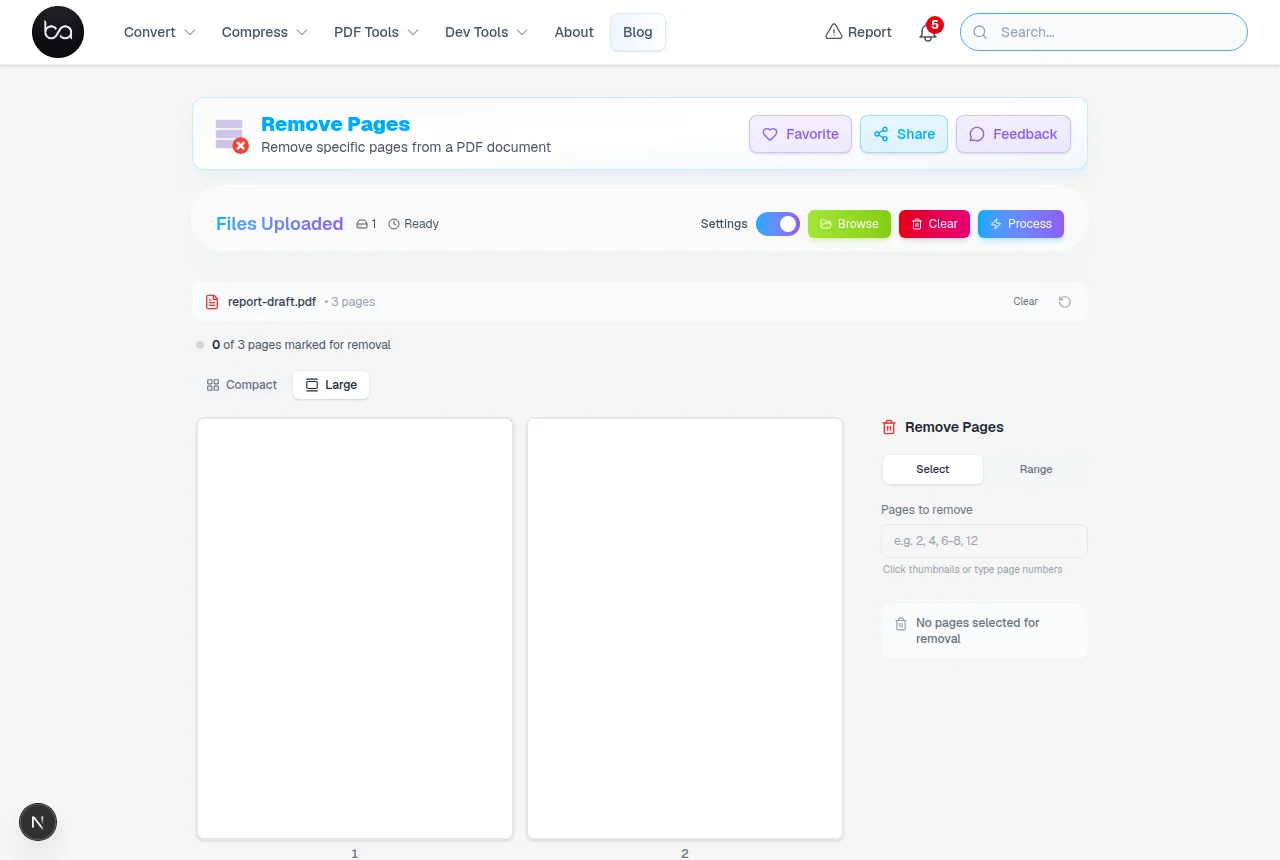
The screenshot below shows what this looks like in practice — pages 1 and 3 are selected (red overlay), page 2 stays clean. The sidebar on the right shows a running count of what will be removed vs. what remains.
Method 2: Range-Based Removal
- Switch to "Range" mode in the removal sidebar
- Set "From" and "To" values for each range you want to remove
- Add multiple ranges using the "Add range" button for complex selections
- The tool automatically validates ranges and prevents overlapping selections
- Visual thumbnails update in real-time to show which pages will be removed
- Process the document once you've confirmed all ranges
Range mode is quicker when you know the page numbers. Type "1-2" and pages 1 and 2 go red in the thumbnail grid without you clicking each one individually. Useful for removing a cover sheet plus a blank page before the main content, or stripping a back-page appendix from a 60-page document.
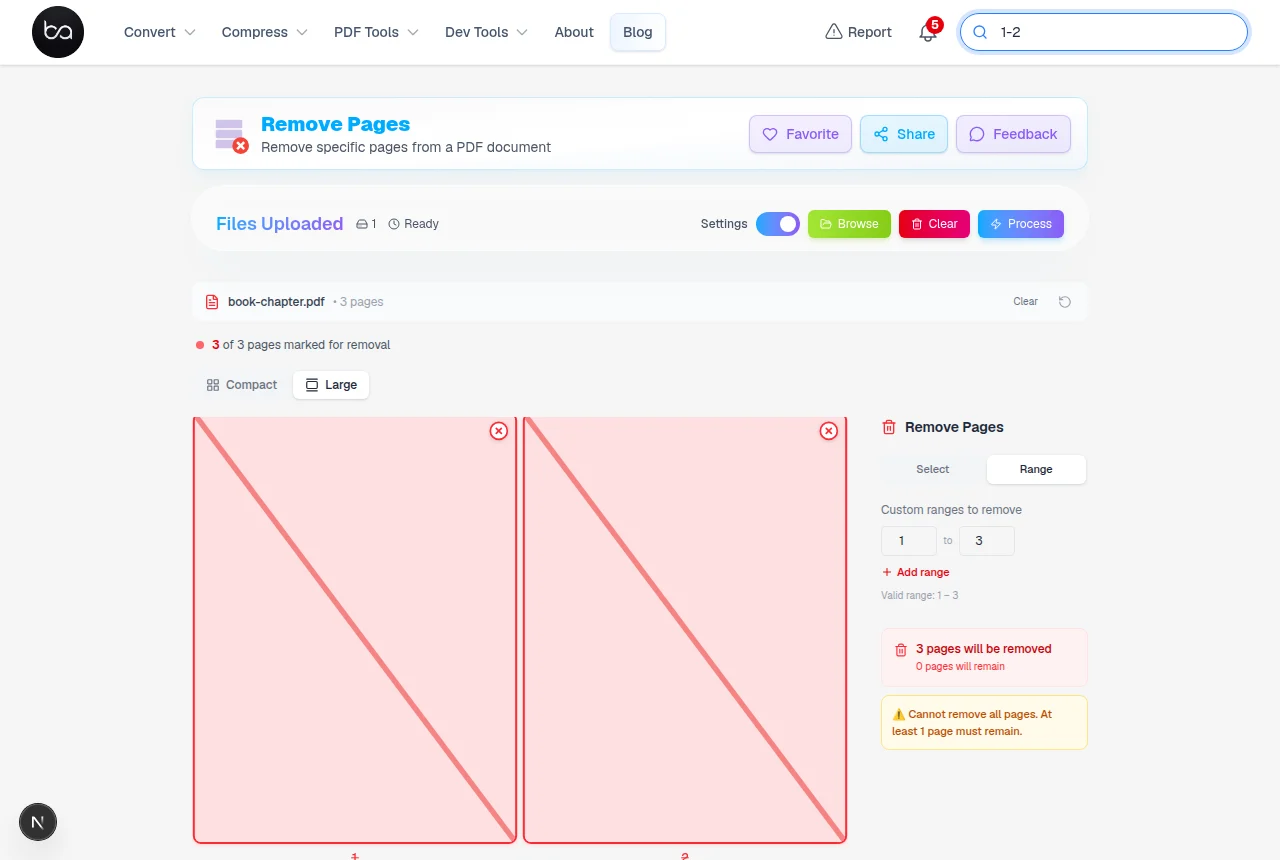
Both methods include built-in validation to prevent removing all pages from a document. The tool requires at least one page to remain in the final PDF, displaying warning messages if you attempt to select all pages.
What Happens to Bookmarks and Links When Pages Are Removed
PDF page removal requires modern browser features for client-side processing. Here are the specific compatibility requirements and version support data:
| Browser | Minimum Version | Recommended Version | Support Status |
|---|---|---|---|
| Chrome | 90+ | 118+ | Full Support |
| Firefox | 88+ | 115+ | Full Support |
| Safari | 14.1+ | 16+ | Full Support |
| Edge | 90+ | 118+ | Full Support |
| Opera | 76+ | 100+ | Full Support |
PDF won't load or shows a corrupt page?
Try repairing the file first. Corrupt PDFs often fail silently during page removal and produce a broken output.
Repair PDF →System Requirements
- Minimum 4GB RAM (8GB recommended for documents over 50 pages)
- JavaScript enabled (required for PDF.js processing)
- Canvas API support (available in all modern browsers)
- File API support for drag-and-drop functionality
- WebAssembly support (automatically detected and utilized)
Mobile devices running iOS 14+ or Android 10+ handle smaller documents fine. For anything over 30 pages, a desktop browser is more reliable.
Advanced Features Worth Knowing
A couple of features worth knowing about:
Password-Protected PDF Support
The tool automatically detects password-protected PDFs and provides a secure unlock interface. Password validation occurs entirely in your browser using PDF.js encryption handling. Common password types supported include:
- User passwords (40-bit and 128-bit RC4 encryption)
- Owner passwords (for documents with editing restrictions)
- AES encryption (128-bit and 256-bit)
- Certificate-based security (limited support)
Thumbnail Rendering Modes
Two viewing modes optimize the page selection experience for different use cases. Compact mode displays thumbnails at 150x200 pixels for quick browsing of many pages. Large mode renders thumbnails at 360x480 pixels for detailed page content review.
Large mode thumbnails generate on-demand when switching views, using higher resolution (1.2x scale) for better text readability and image clarity. This approach reduces initial loading time while maintaining quality when needed.
Privacy and Data Security
- Complete client-side processing - documents never leave your device
- No server uploads or cloud storage involvement
- Temporary files cleared automatically when closing browser tab
- No tracking or analytics on document content
- Password handling occurs locally without network transmission
Common Errors and Troubleshooting Solutions
A few things that can go wrong and what to do:
Error Codes and Solutions
| Error Type | Symptoms | Solution |
|---|---|---|
| PasswordException | Document fails to load, shows password prompt | Enter correct password or contact document owner |
| Single Page Error | Warning displayed, processing disabled | Use multi-page PDF or try PDF splitting tool |
| Memory Limit | Browser freezes or crashes with large files | Close other tabs, increase available RAM, or use desktop browser |
| Corrupted PDF | Thumbnail generation fails partially | Try PDF repair tool first, then retry page removal |
| Invalid Page Range | Red validation warning appears | Check page numbers are within document range and "from" ≤ "to" |
Performance Optimization Tips
- Close unnecessary browser tabs to free memory before processing large PDFs
- Use Compact view mode for documents over 100 pages to improve responsiveness
- Allow thumbnail generation to complete before making page selections
- For very large documents, consider splitting into smaller sections first
- Disable browser extensions that modify page content during processing
Comparison with Alternative Methods
Several methods exist for removing PDF pages, each with distinct advantages and limitations. This comparison helps you choose the most suitable approach for your specific needs.
| Method | Privacy | Cost | Ease of Use |
|---|---|---|---|
| This Browser Tool | High — file never leaves browser | Free | Very Easy |
| Adobe Acrobat Pro | High — processes locally | $15–20/month | Moderate |
| Online PDF Editors | Lower — file uploaded to server | Free–$10/month | Easy |
| Print-to-PDF | High — local | Free | Difficult — error-prone |
| Programming Libraries | High — local | Free (time cost) | Very Difficult |
Need to edit the remaining content? Convert the trimmed PDF to Word so you can rewrite, reformat, or repurpose sections freely.PDF to Word
Detailed Feature Comparison
Our browser-based tool offers significant advantages for occasional to moderate PDF editing needs. Unlike desktop software, it requires no installation or updates. Compared to server-based tools, it maintains complete document privacy.
Adobe Acrobat Pro provides faster processing and additional editing features but requires expensive subscription licensing. The print-to-PDF method involves manually selecting pages in print dialogs, making it error-prone for complex page removal tasks.
Python libraries like PyPDF2 or PDFtk give maximum control if you're comfortable scripting, but that's overkill for removing a few pages from a one-off document.
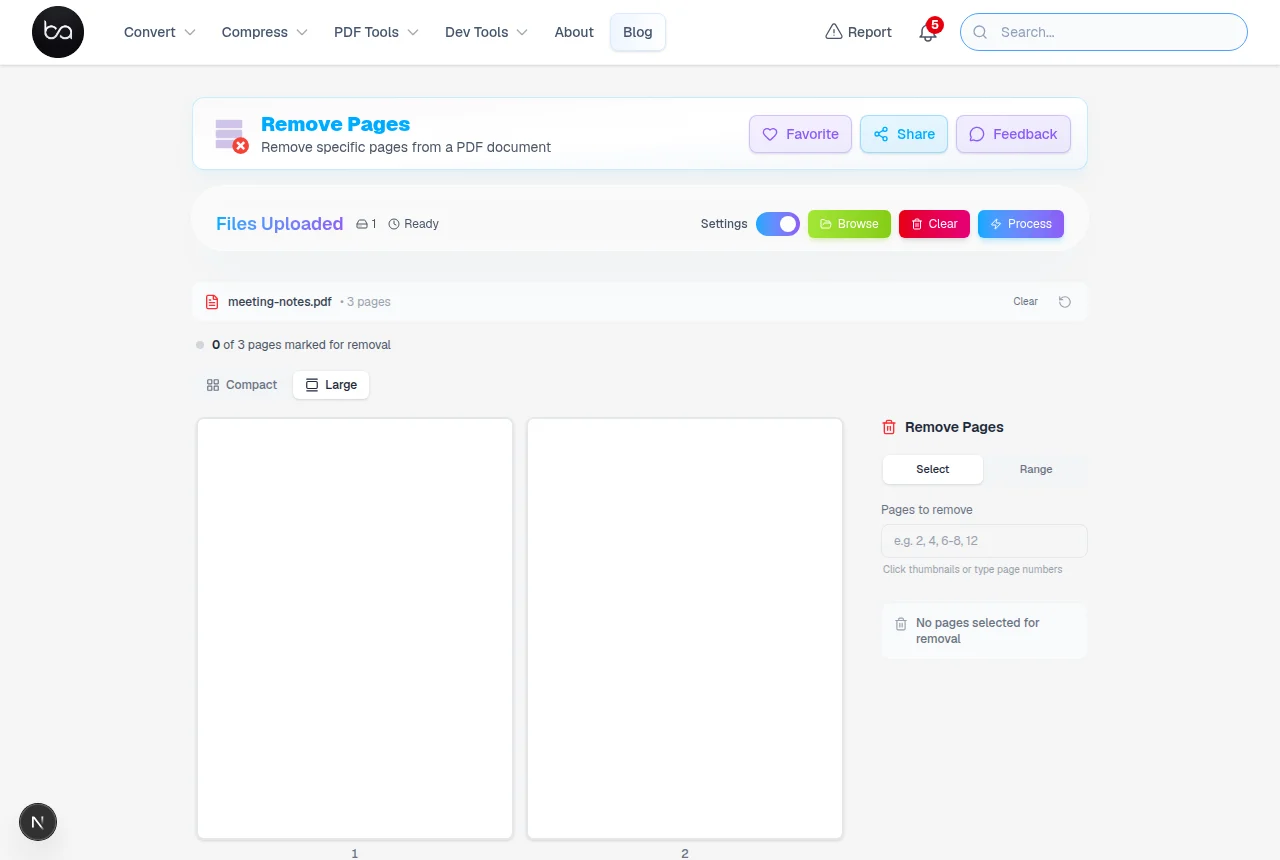
If you want a quick look at the full interface before uploading your own file — here's what it looks like after a document loads. Page thumbnails on the left, selection controls on the right, download button at the bottom.
Frequently Asked Questions
Can I remove pages from password-protected PDFs?
Yes. Enter the document password when prompted — everything else works normally.
What happens to bookmarks and links when removing pages?
Bookmarks pointing to removed pages are deleted. Bookmarks pointing to surviving pages are preserved and their page-number references are updated to reflect the new count. Internal hyperlinks between remaining pages are also corrected. Cross-document links on removed pages disappear with the page, which is expected behaviour rather than a bug.
Is there a limit on PDF file size or page count?
File size is limited by your browser's available memory. Most files under 100MB work fine in any modern browser. Very large files may need other tabs closed to free memory first.
Will removing pages affect document quality or formatting?
No, page removal preserves original document quality and formatting. The tool reconstructs the PDF structure without recompressing images or altering text rendering, maintaining identical quality to the original.
Can I undo page removal after processing?
Page removal is permanent once processed. The tool creates a new PDF with specified pages excluded. Always keep a copy of your original document before removing pages, as the operation cannot be reversed.
Removing pages but want to keep them in a separate file?
Use the Extract tool to pull those pages into their own PDF before deleting them from the original.
Related Articles
Convert PDF to Word Free With OCR - Keep Tables and Text Intact
Convert PDF documents to editable Word files online free. Handle scanned PDFs with OCR, preserve tables and formatting, support password-protected files. No signup required.
Read articleOCR PDF Free to Extracting Text from Scanned Documents
Convert scanned PDFs into searchable, editable text documents with advanced OCR technology. Support for 25+ languages, auto-straightening, smart processing modes, and troubleshooting methods for maximum accuracy. Learn performance benchmarks and compatibility requirements.
Read articleConvert Excel to PDF Without Cutting Off Columns - Free Tool
Convert Excel spreadsheets to PDF online free. No more cut-off columns or cramped data. Perfect landscape orientation for wide sheets. Works with XLS and XLSX files.
Read article