
Screen-capture sharp · No signup · Free
Convert WebM to GIF — Keep Text Sharp in Screen Recordings
Screen recordings I made for a tutorial series came out as WebM files and the platform I posted on only accepted GIF for inline animations — the conversion preserved text clarity in the screen captures well enough to read every line. The key to keeping text sharp is setting a high enough resolution — don't reduce width below the point where UI elements become illegible.
This is the tool after the WebM file is accepted — codec detection and alpha-channel check happen before conversion controls appear.
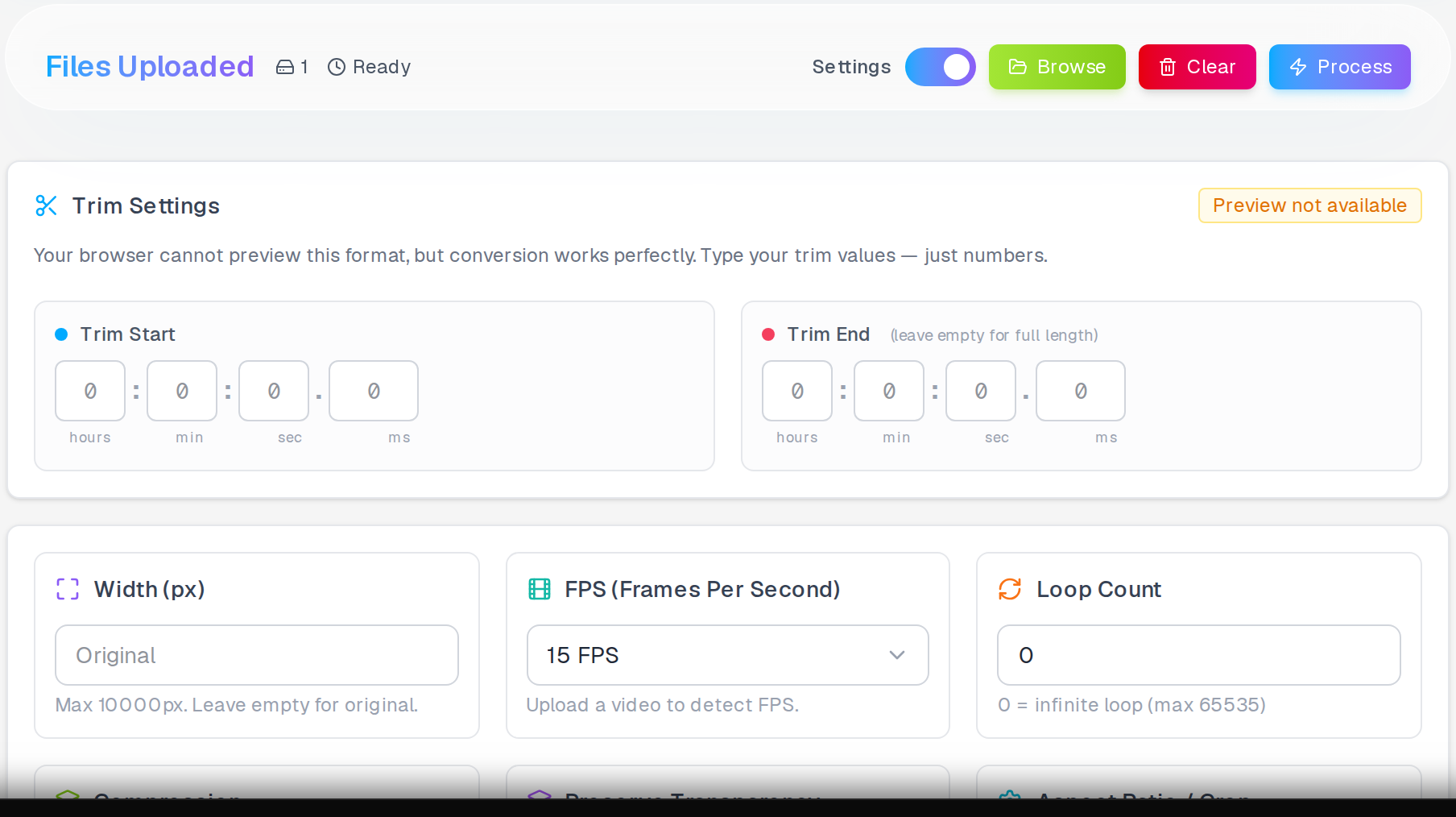
Understanding WebM vs GIF Format Differences
WebM files use modern video compression algorithms that support higher resolutions and richer color than GIF's 256-color limit. However, GIFs remain universally popular because they auto-play everywhere without a video player or codec. If you need something more compact than a GIF for video-friendly platforms, you can convert the result to MP4 afterward for significantly smaller file sizes.
The main challenge lies in format limitations. GIFs are restricted to 256 colors per frame, while WebM supports millions of colors. This color limitation often causes the"washed out" look in poorly converted GIFs.
Frame rate differences also matter. WebM videos can have variable frame rates up to 60 FPS or higher. GIFs technically support any frame rate, but most browsers and platforms optimize for 10-20 FPS to balance file size and smoothness.
| Aspect | WebM | GIF |
|---|---|---|
| Color Support | 16.7 million colors | 256 colors per frame |
| Compression | Modern video codecs | LZW compression |
| Browser Support | Requires video tag | Universal support |
| Transparency | Alpha channel support | Single transparent color |
| File Size | Typically smaller | Can be very large |
Step-by-Step WebM to GIF Conversion Process
Knowing what happens during WebM-to-GIF conversion helps you choose better quality settings for your specific content.
Three settings control output quality: frame rate, output width, and whether the alpha channel is preserved.
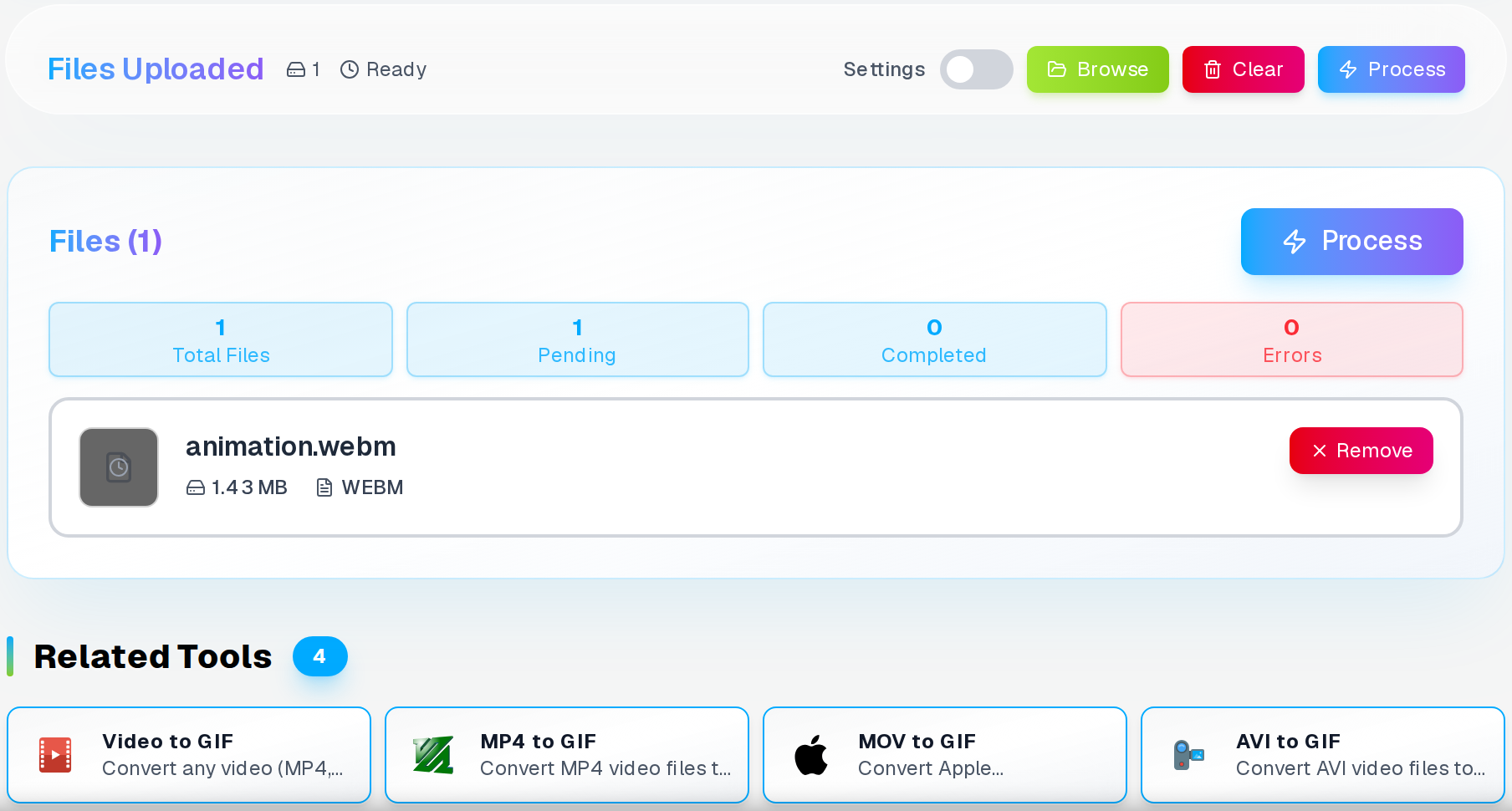
First, the tool analyzes your WebM file using MediaInfo technology. This extracts crucial information like original frame rate, duration, resolution, and whether the video contains transparency data. This analysis determines the optimal default settings for your specific file.
- Upload and Analysis: The system detects your WebM file properties including FPS, duration, and transparency channels. This automatic detection prevents common conversion errors.
- Frame Rate Optimization: Based on your source video, the tool suggests optimal FPS settings. Higher source frame rates get automatically capped at 30 FPS for GIF compatibility.
- Color Palette Generation: Advanced algorithms analyze your video content to create optimized color palettes for each frame, maximizing quality within GIF limitations.
- Compression Application: Smart compression reduces file size while preserving visual quality in areas where viewers notice changes most.
- Loop Configuration: The final GIF gets configured with your chosen loop settings, from single playback to infinite loops.
Settings Cards
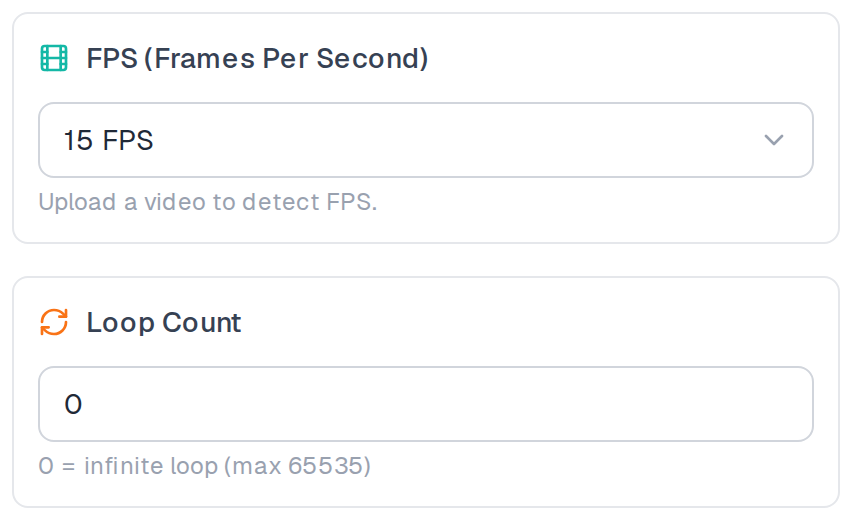
FPS and loop — the two cards that matter most
The FPS card caps how many frames per second the decoder samples from the WebM. Halving FPS from 20 to 10 typically cuts the GIF file size by 40 % with barely perceptible slowdown. The loop card beneath it controls how many times the GIF cycles in the browser.
15 FPS with infinite loop (0) is the safe default for social sharing. Drop to 10 FPS for clips longer than 4 seconds to stay under platform size caps.
Advanced Quality Optimization Techniques
Most people accept default settings and wonder why their GIFs look terrible. Professional-quality results require understanding how different settings interact with each other.
Frame rate selection impacts both quality and file size dramatically. A 30 FPS GIF might look smooth but could be 5-10 times larger than a 15 FPS version. The human eye typically perceives 12-15 FPS as smooth for most content types.
Width settings affect quality more than most realize. Keeping your GIF width under 800 pixels often produces better results than full HD conversions. The GIF format performs better at moderate resolutions where color limitations become less noticeable.
- For social media sharing: 480-600px width, 12-15 FPS
- For website headers: 800-1000px width, 10-12 FPS
- For product demonstrations: 600-800px width, 15-20 FPS
- For reaction GIFs: 300-400px width, 8-12 FPS
- For technical tutorials: 800-1200px width, 8-10 FPS
Compression levels require careful balancing. Level 0 produces the largest files but maintains maximum quality. Levels 10-15 offer the best quality-to-size ratio for most use cases. Levels above 18 should only be used when file size is absolutely critical.
When WebM-to-GIF Looks Washed Out or Slow
GIF from an AVI or MOV?
Convert AVI, MOV, and other video formats to GIF with the same quality, speed, and compression controls.
AVI to GIF →Choppy playback usually indicates frame rate mismatch issues. If your source WebM runs at 24 FPS but you convert to 30 FPS, the tool must duplicate frames, causing irregular playback timing.
Blurry results often come from excessive compression or inappropriate width settings. GIFs with high compression levels lose fine details that your eyes expect to see, creating a soft or blurred appearance.
Color banding appears when the 256-color limit forces similar colors to use identical palette entries. This creates visible steps between color gradients instead of smooth transitions.
File size problems typically stem from unrealistic expectations. A 10-second, full HD, 30 FPS GIF might exceed 50MB easily. Understanding format limitations helps set appropriate conversion parameters.
- Choppy Playback: Match GIF FPS to source video FPS or use divisors (30 FPS source → 15 FPS GIF)
- Poor Color Quality: Reduce compression levels and avoid extreme width reductions
- Large File Sizes: Increase compression, reduce FPS, or trim video length
- Transparency Issues: Enable preserve transparency option for WebM files with alpha channels
- Playback Speed Problems: Use speed multipliers instead of changing frame rates
What People Actually Convert WebM to GIF For
GIF too large to share?
Convert your GIF to MP4 — 60% smaller file size with far better quality for social media and messaging platforms.
Social media platforms handle GIFs differently than native videos. Instagram Stories, Twitter posts, and Discord messages often display GIFs more reliably than WebM files, especially on mobile devices.
Email marketing campaigns benefit from GIF compatibility. While modern email clients support video, GIFs ensure your animated content displays correctly across all recipients, including older email software.
Website integration scenarios favor GIFs for several reasons. GIFs start playing immediately without user interaction, unlike videos that require click-to-play in many browsers. This makes them perfect for product showcases and tutorial previews.
Documentation and tutorials often need frame-by-frame clarity that videos don't provide. GIFs allow viewers to see each step clearly without video compression artifacts that might hide important UI elements.
Security and Privacy Considerations
File processing security matters when handling personal or business content. Choose tools that process files locally in your browser rather than uploading to remote servers where data might be stored or analyzed.
Browser-based conversion tools offer better privacy protection because your files never leave your device. Server-based tools might retain copies of your videos for processing optimization or other purposes.
Metadata removal becomes important for sensitive content. WebM files can contain creation timestamps, device information, and location data. Quality conversion tools strip this metadata from output GIFs automatically.
Consider the content sensitivity before using any online conversion tool. Business presentations, personal videos, or proprietary content should be processed using tools with clear privacy policies and local processing capabilities.
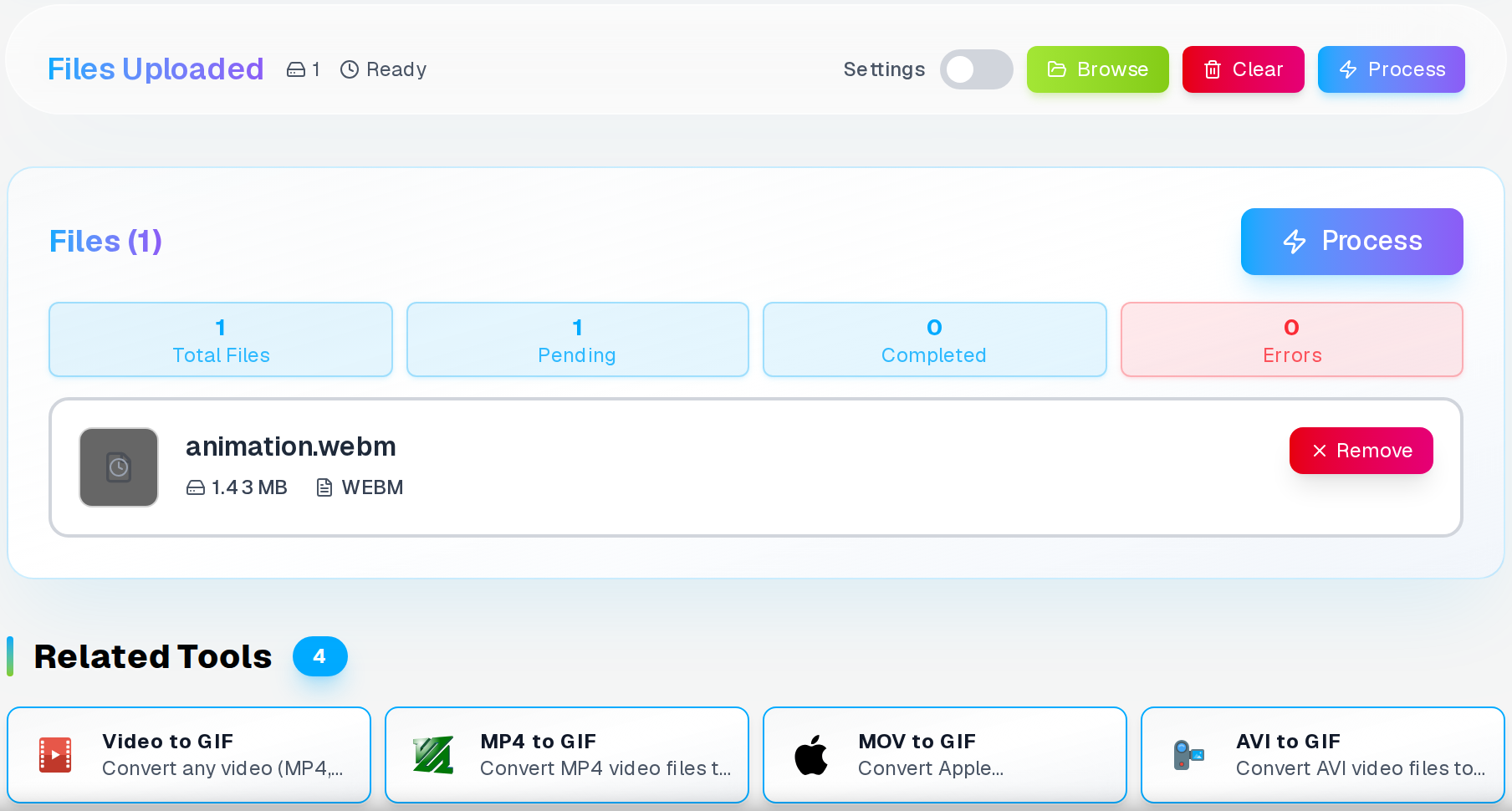
After conversion, the result screen shows the final GIF size — important to check since WebM sources are often screen recordings with a lot of repeated content.
Frequently Asked Questions
Why do my converted GIFs look blurry compared to the original WebM?
GIF format limitations cause this issue. GIFs support only 256 colors per frame while WebM supports millions. High compression levels and inappropriate width settings worsen the problem. Use lower compression levels (5-10), maintain reasonable width (under 1000px), and ensure your FPS matches or divides evenly into your source frame rate.
What is the maximum file size I can expect from WebM to GIF conversion?
A 5-second, 800px-wide, 15 FPS GIF typically runs 2-8MB depending on motion complexity.
How do I preserve transparency when converting WebM files with alpha channels?
Enable preserve transparency in the converter settings. GIF transparency is fundamentally different from WebM: GIF supports one transparent colour per frame, while WebM supports full alpha with 256 opacity levels per pixel. That gap means semi-transparent edges become either fully transparent or fully opaque, creating jagged outlines. For content where transparency quality matters, APNG is a significantly better output format.
Can I convert very long WebM videos to GIF format?
Technically yes, but practically challenging due to file size constraints. GIFs larger than 10-20MB become difficult to share and slow to load. Use video trimming to convert only essential portions, reduce frame rate to 8-12 FPS for longer content, or split long videos into multiple shorter GIFs.
Why does my GIF play at the wrong speed compared to the original WebM?
Frame rate mismatches cause speed differences. If your WebM plays at 24 FPS but converts to 30 FPS GIF, playback appears faster. Use speed adjustment settings instead of changing frame rates, or ensure your output FPS matches your source FPS exactly for identical playback speed.
Need higher quality than GIF?
Convert your GIF to APNG for millions of colours and full transparency — much better than the 256-colour GIF limit.
Related Articles
Convert GIF to APNG for Better Color Quality - Fix Color Banding Free
Convert GIF to APNG online free. Fix color banding and poor color quality in animations. APNG supports millions of colors vs GIF 256 limit. Better transparency and quality.
Read article
Convert SVG to JPG for Social Media Posts - Keep Quality Sharp
Convert SVG vector graphics to JPG images online free. Perfect for social media, web use, and sharing. Control resolution and quality. Works in browser, no signup required.
Read articleRemove Pages From PDF Free to PDF Page Deletion
Remove unwanted pages from PDF documents instantly. Delete specific pages, ranges, or multiple selections with interactive thumbnails. Learn performance benchmarks, troubleshooting tips, and browser compatibility requirements for professional PDF page removal.
Read article